
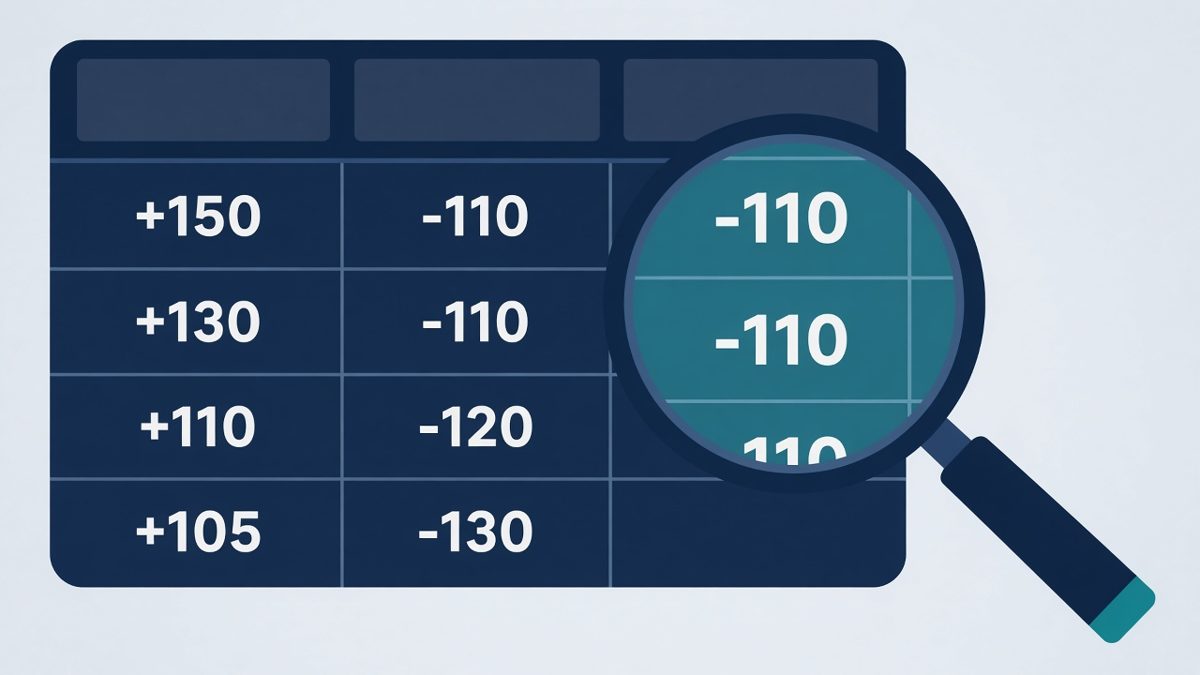
Parlay odds look tempting because a small stake can show a large potential payout. But parlay odds are just several individual prices multiplied together, and the math behind them shows why the bookmaker’s margin grows with every leg you add. This guide walks through the calculation step by step, using numbers you can verify yourself.
What a Parlay Actually Is
A parlay (also called an accumulator or multi) combines two or more selections into one wager. Every leg must win for the bet to pay. If a single leg loses, the whole ticket loses; if a leg is a push or is voided, most sportsbooks simply remove it and recalculate at the remaining legs’ odds. Because the outcomes must all happen together, the combined chance of winning is lower than the chance of any single leg.
Converting to Decimal and Multiplying the Legs
The cleanest way to calculate parlay odds is to work in decimal format, where the number is your total return per unit staked, including the stake. If you are unsure about formats, see our guide on how to read betting odds. Two conversions matter most:
- Negative American odds: decimal = 1 + 100 ÷ |odds|. For -110, that is 1 + 100/110 = 1.9091.
- Positive American odds: decimal = 1 + odds ÷ 100. For +150, that is 2.50.
Once every leg is in decimal form, you multiply. The combined decimal price is the product of all the leg prices. To turn it back into American odds: if the decimal is 2.00 or higher, American = (decimal – 1) × 100; if it is below 2.00, American = -100 ÷ (decimal – 1).
Worked Example: A Three-Leg Parlay at -110
Suppose you combine three separate point-spread bets, each priced at -110 (decimal 1.9091).
- Multiply: 1.9091 × 1.9091 × 1.9091 ≈ 6.958.
- Convert to American: (6.958 – 1) × 100 ≈ +596.
- On a $10 stake, the total return if all three win is about $69.58, which is a profit of $59.58.
Now compare that with the true chance of winning. Assume, generously, that each leg is a genuine 50% proposition. The chance all three win is 0.5 × 0.5 × 0.5 = 12.5%, which corresponds to fair odds of 8.00 (+700). The sportsbook pays 6.958, so the expected value per $10 is:
0.125 × $69.58 – $10 = -$1.30, or about -13.0% of the stake.
A single -110 bet on a true 50% outcome has an expected value of 0.5 × $19.09 – $10 = -$0.45, or about -4.5%. The parlay roughly triples the built-in cost in this example.
The Break-Even Win Rate Per Leg
A useful way to think about a parlay is to ask what each leg must achieve just to break even. At -110, the implied probability is 110 ÷ 210 = 52.38%. For a three-leg parlay at that price, every leg would need to win about 52.38% of the time, because 0.5238 × 0.5238 × 0.5238 ≈ 14.37%, and 1 ÷ 6.958 is also 14.37%. Compare that with the 50% assumption above and the gap is clear: the parlay does not change the required edge per leg, it simply makes the losses arrive more often and the swings larger.
Why the House Edge Compounds
Each leg carries its own margin, often called the vig or juice. When you multiply prices, you multiply those margins too. The table below shows the same 50% legs at -110 with more legs added.
| Legs | Combined decimal | True win chance | Expected value |
|---|---|---|---|
| 1 | 1.909 | 50.0% | -4.5% |
| 3 | 6.958 | 12.5% | -13.0% |
| 4 | 13.283 | 6.25% | -17.0% |
To understand how a price converts to a probability, read implied probability and expected value. To see how the margin is separated from a price, see how to calculate no-vig odds and fair probability.
In practice, this means your estimate of each leg matters far more than the number of legs. Small errors in probability estimates also multiply, so a parlay magnifies mistakes as well as margin. Tracking your results over a large sample is the only reliable way to learn whether your estimates are any good.
Correlation and Same-Game Parlays
Simple multiplication assumes the legs are independent. In a same-game parlay they usually are not: a team winning and its quarterback going over a passing total are linked. Sportsbooks price this correlation into the combined odds, and they often apply extra margin. Never assume that correlated legs are automatically favorable; the price already reflects the relationship, and the operator sets the final number.
Frequently Asked Questions
Can a parlay ever have positive expected value?
Yes, in principle, if the true probabilities are higher than the prices imply for every leg. The margin makes that hard, and estimating true probabilities is uncertain. Shopping for better prices, as covered in comparing odds across sportsbooks, reduces the cost but does not remove risk.
Why do payouts jump so quickly with more legs?
Because prices multiply. Adding a 1.91 leg roughly doubles the decimal odds, but the true chance of winning also roughly halves, and the margin grows each time.
What happens if one leg is a push?
Most books drop that leg and price the parlay on the remaining legs. Rules vary, so check the terms of your operator.
Conclusion
Parlay odds are straightforward arithmetic: convert to decimal, multiply, and compare the result to the true probability. The larger payout is compensation for a much lower chance of winning, and the bookmaker’s margin compounds along the way. Understanding this math helps you judge any ticket realistically rather than by its headline payout.
Educational content only, not betting advice. Please gamble responsibly; 21+ where applicable.